Healthcare protocols save lives


I highly recommend this excellent article in the NYTimes about how we can use data to create healthcare protocols that dramatically improve outcomes and reduce overall costs. (This is what we were trying to do in Malawi and what I am trying to introduce in the Philippines)

Here are the key points that I want to remember:

To enter mainstream use, any such treatment typically needs to clear a high bar. It will be subject to randomized trials, statistical-significance tests, the peer-review process of academic journals and the scrutiny of government regulators. Yet once a treatment enters the mainstream — once we know whether it works in certain situations — science is largely left behind. The next questions — when to use it and on which patients — become matters of judgment, not measurement. The decision is, once again, left to a doctor’s informed intuition.
...
“Guys, it’s more important that you do it the same way than what you think is the right way.”
...
Whenever possible, the guidelines are also embedded in the hospital’s computer system. Doctors and nurses are presented with a default choice — how much of a given drug to prescribe, for example — and have the option of overriding it. Most important, the electronic records system allows both committees and doctors to track patient outcomes.
...
He could not simply tell Intermountain’s doctors what to do, no matter how much research he brought to bear. Doctors have a degree of professional autonomy that is probably unmatched outside academia. And that is how we like it. We think of our doctors as wise men and women who can combine knowledge and instinct to land on just the right treatment.
...
Perhaps the clearest example is the Pronovost checklist. As many as 28,000 people in this country die each year from infections that come from intravenous lines. Several years ago, Peter Pronovost, a Johns Hopkins physician, developed a simple list of five steps that intensive-care doctors should take before inserting an IV line, in order to prevent the introduction of bacteria. The checklist reduced the infection rate to essentially zero at 108 hospitals in Michigan where it was adopted. Pronovost published the results in The New England Journal of Medicine
...
But in our current health care system, there is no virtuous cycle of innovation, success and expansion. When Intermountain standardized lung care for premature babies, it not only cut the number who went on a ventilator by more than 75 percent; it also reduced costs by hundreds of thousands of dollars a year. Perversely, Intermountain’s revenues were reduced by even more. Altogether, Intermountain lost $329,000. Thanks to the fee-for-service system, the hospital had been making money off substandard care. And by improving care — by reducing the number of babies on ventilators — it lost money. As James tartly said, “We got screwed pretty badly on that.”
...
As long as doctors and hospitals are paid for each extra test and treatment, they will err on the side of more care and not always better care. No doctor or no single hospital can change that. It requires action by the government.
...
Yet somehow, both doctors and patients have come to imagine that a physician can accomplish far more than any human being reasonably can. As a result, modern medicine is accomplishing far less than it reasonably should.

Childcare Amazon.com style


Noise blocking earmuffs...check
Music...check
Children locked away in kiddie jail...check

ssh all the time


Using autossh and reverse ssh tunneling to bust out of NAT'd networks and firewalls automatically.

In another lifetime I blogged about how to reverse an ssh connection. This was by far my most popular post ever. It earned enough in google ad money to cover my hosting costs. Those were the days. Those days are gone, and now lots of people have blogged about using reverse ssh tunnels. It's time to take it to the next level and make reverse ssh tunnels easy and ubiquitous.

I want all of my machines to be setup with an ssh tunnel whenever one of them finds an internet connection. That way I can always access all of my machines no matter where I, or they are the world. I want this even if they are in some high security firewalled corporate prison or if they are sharing the same IP address as the other million NAT'd users tethering internet through their phones. This should happen automatically and without fuss.

To do this you need to have ssh access to a machine that can be seen from the internet, and the ssh daemon machine needs to have the GatewayPorts option set to yes (this is not the default). See my old post for more information.

Here's the recipe.

(Update! I have made this much easier by scripting the whole process, see the bottom of the post!)

Create a file:

/etc/network/if-up.d/reverse_ssh_tunnel

(you are using Ubuntu, right?)

Put this in it:

#!/bin/sh
# ------------------------------
# autossh reverse tunnel on boot
# ------------------------------
# See autossh and google for reverse ssh tunnels to see how this works

# When this script runs it will allow you to ssh into this machine even if it is behind a firewall or has a NAT'd IP address.
# From any ssh capable machine you just type ssh -p $PORT_MIDDLEMAN_WILL_LISTEN_ON localusername@middleman

# This is the username on your local server who has public key authentication setup at the middleman
USER_TO_SSH_IN_AS=change_me

# This is the username and hostname/IP address for the middleman (internet accessible server)
MIDDLEMAN_SERVER_AND_USERNAME=luser@example.com

# The following two numbers can be whatever you want, but need to be unique if you have multiple reverse ssh tunnels
# Port that the middleman will listen on (use this value as the -p argument when sshing)
PORT_MIDDLEMAN_WILL_LISTEN_ON=11829

# Connection monitoring port, don't need to know this one
AUTOSSH_PORT=27554

# Ensures that autossh keeps trying to connect
AUTOSSH_GATETIME=0

export AUTOSSH_PORT AUTOSSH_GATETIME

su -c "autossh -f -N -R *:${PORT_MIDDLEMAN_WILL_LISTEN_ON}:localhost:22 ${MIDDLEMAN_SERVER_AND_USERNAME} -oLogLevel=error -oUserKnownHostsFile=/dev/null -oStrictHostKeyChecking=no" $USER_TO_SSH_IN_AS


Make sure that you fill in the values to match your own logins (send me a comment if you are confused about what to put in).

Now whenever the machine acquires an internet connection it will run the above script (that is why we put it in /etc/network/if-up.d). Then from any internet connection you can ssh -p 11829 USER_TO_SSH_IN_AS@MIDDLEMAN and you will get forwarded to your own machine.

You should put this on all of your machines. That is all.

Oh one more thing. For this to work you need to have passwordless public key authentication working between your machine and the middleman. Use this:


ssh-copy-id


It will take care of all of the gory details of copying and concatenating your keys so that you can ssh in without typing anything.

This blog post is a mess and needs some serious revision, but I needed to post it, if for no other reason so that I could find the info when I needed it!

Update

I put everything you need to set this up into a script on github. If you have a server out on the internet with the GatewayPorts option turned on, then all you need to do is the following:


wget http://github.com/mikeymckay/reverse_ssh_tunnel/raw/master/setup_reverse_tunnel.sh
chmod +x ./setup_reverse_tunnel.sh
sudo ./setup_reverse_tunnel.sh
:

Someone is doing something nasty


Someone is doing something nasty. That's the title of my favorite Linux error message. It's to stop another computer from emulating another computer in order to try and steal passwords. They call this a man in the middle attack.

Unfortunately, I am always caught doing something nasty. It's because I work with a lot of Linux machines, and I setup VirtualBox or VMWare servers, and each new server looks like an untrusted machine when I try and ssh to it. This always results in me getting this:


@@@@@@@@@@@@@@@@@@@@@@@@@@@@@@@@@@@@@@@@@@@@@@@@@@@@@@@@@@@
@ WARNING: REMOTE HOST IDENTIFICATION HAS CHANGED! @
@@@@@@@@@@@@@@@@@@@@@@@@@@@@@@@@@@@@@@@@@@@@@@@@@@@@@@@@@@@
IT IS POSSIBLE THAT SOMEONE IS DOING SOMETHING NASTY!
Someone could be eavesdropping on you right now (man-in-the-middle attack)!
It is also possible that the RSA host key has just been changed.
The fingerprint for the RSA key sent by the remote host is
d7:63:c7:d5:65:55:33:fc:bf:b5:d6:f9:c1:a5:2e:d6.
Please contact your system administrator.
Add correct host key in /home/crazy/.ssh/known_hosts to get rid of this message.
Offending key in /home/crazy/.ssh/known_hosts:66
RSA host key for [localhost]:2222 has changed and you have requested strict checking.
Host key verification failed.


So then I have to open up the known_hosts file, find the line, delete it and then reconnect.

After years of doing the nasty like this, I finally figured out how to use the ssh config file to solve this problem (and do other cool stuff too):

From ~/.ssh/config:

Host chits
Port 2222
HostName localhost
UserKnownHostsFile /dev/null
StrictHostKeyChecking no
LogLevel error
User chits


This combines a couple of nice things. Here is the stuff that protects you from the nasty:


UserKnownHostsFile /dev/null
StrictHostKeyChecking no
LogLevel error


It looks at the null file to check for a match on the new server's key. It eases off the strict-o-ness level, and it doesn't bore with warnings that you already know.

The other stuff just makes it require less typing to login to my virtual servers which listen on strange ports and require funny user names.

Simply deploy Sinatra permanently


Sinatra is an awesome tool for creating dynamic websites really really fast. But their deployment recommendations just don't match their overall KISS ethos. So here is my recommendation if you want to deploy a sinatra app really quickly:

If your sinatra app is in:

/var/www/sinatra/cool_app.rb

Just insert in /etc/rc.local (before the "exit 0" line)

nohup /usr/bin/ruby /var/www/sinatra/cool_app.rb&

And then run the same command. Now your application is running, and the next time your system reboots it will start up again.

---

Update. I probably wouldn't recommend doing this anymore. The world has come a long way since then. It's still a pain to do this right (using something like apache passenger), but you can do a lot better than the above by doing a few more things:

Install shotgun and thin:

sudo gem install shotgun thin

And then put this at the end of /etc/rc.local:

/usr/local/bin/shotgun /var/www/sinatra/cool_app.rb&


It should work the same as before, but also be able to handle more than one request at a time.

Open source software needs designers

A friend recently challenged me with the following hypothesis: Open source is something that is valuable to programmers but when programmers are writing open source software they have no incentive to build software that is useful for end users. Because of this, we we end up with overly complex software that may not even address the need of the end users and hence the original intent of the project.

After thinking about this for awhile I have decided that I agree that there is a serious disconnect between software developers and end users, but I don't think open source has much to do with it. Programmers are good at logical thinking (without emotion), understanding complex documentation (pages of text), and holding multiple concepts and equations in their heads at the same time. In fact they tend to thrive on this kind of stuff. Case in point, I was just looking at a product that allows you to remotely control someone else's PC. Let's have a look at two images on their site:


Whether you are a computer programmer or not, that is a terrible attempt to communicate something. The only thing it communicates to me is that this setup is complex. Perhaps that is how the programmer's mind visualizes what he is building, and that is fine, but let's keep our private parts (brain dumps included) to ourselves, eh?
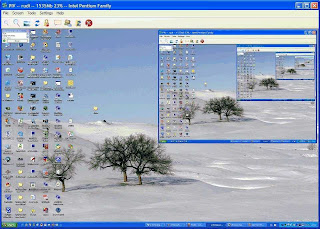


I thought this second image (they are both on the same page) was pretty funny. Instead of explaining that the software can help your mom when she "loses the internet" by letting you control her computer from afar, the developer decides to show you how you can recursively connect to yourself and create an infinite number of desktops within desktops. "Whoa dude, isn't it crazy what I can do?? I feel like my brain is going to explode!" Sorry, elite hacker dude, it's not cool. It's lame and I am sorry that normal people will never use your software because most people don't like software that makes their brain explode, they like things that help mom. Most people, but not computer programmers. The more head-xplode-dacious the better for geeks!

This problem gets compounded when you have programmers in DC "solving" problems in Africa or the Philippines. Not only do we have the programmer/normal person gap, but we also have a cultural gap (take it from me, never use the word stupid in the Philippines) and a geographical gap (body language and timezones matter). The greater the gap, then the more useless the stuff we end up with is. The more time programmers spend in country the more we can reduce this gap. Or even better, find some programmers from the country itself. This can improve things a lot, but you still have the classic gap between programmers and end users.

The way to solve this is to have programmers never design anything that a user will see, ever. Instead you have designers design stuff and programmers implement it. Back in the dot com days I worked for a big technology consulting firm and every project had at least one business strategy person, a designer and a computer programmer. We created some world changing stuff, but we were expensive, spent a lot of money on flashy artsy offices and flamed out. But I worked with designers and learned to understand their value (and my own shortcomings in that area).

Macs and iphones aren't programmed in California - they are Designed (check the back of your iphone). I hear that Apple has heavily relied on their Silicon neighbor IDEO to do a lot of their design work, or more likely they probably just hired a bunch of IDEO people. IDEO is a pure design firm, they spend most of their time watching and talking with users, and the other part of their time is spent trying to think outside the box by crossing and combining design patterns from disparate genres and seeing if they can come up with something useful. I just installed an iphone app called Party Whistle designed by the IDEO guys. It is the antithesis of the above examples:



When you launch the app you see a party whistle on the screen, and a little icon recommending that you blow into one end of your phone. When you do his, the whistle expands and makes funny noises and all sorts of wacky stuff. Emphasis on wacky. Nothing useful. It doesn't help plan a party or coordinate party favors, it is just wackyness designed elegantly and simply. This is what you get without programmers.

What we really need is to take the brilliant visual ideas of designers and connect them with innovative plumbing that programmers do.

Usually we do this backwards, and we give the problem to the programmer and they plumb it, then they make it so that they can use it, then they try and make it look nice. With a single designer or artist or business plan you have nothing. But with a single programmer you can usually create something, even if that something is just a shadow of what it could be. It's this shadow world of foggy potential that the programmers tend to fester.

How does this relate to open source? It doesn't really. The best programmers hate to create boring stuff like menus and reminder windows because all of that stuff has been done before. They would rather reuse someone else's code so they could focus on doing the really challenging (brain exploding?) part. This is how programmers are wired, so if they aren't allowed to use open source they will be less happy and will be forced to waste their time on reinventing the wheel. Whether it is open or not will have no impact on usability.

Open source lets programmers stand on the shoulders of giants and build the stuff that they think is important and cool. As a result open source has little to do with cost (of any kind) and more to do with creating an easy way for programmers to share, communicate and collaborate. I prefer working with open source software because I can find other developers trying solve the same problems on IRC. I can google for documentation and wiki my own thoughts to it so that others benefit and see how cool I am. I can join mailing lists. It also means that open source programmers write their code so that others can read it and use it and modify it easily. All of this leads to high-productivity, innovation and personal fulfillment for open sourcers.

It doesn't lead to good user centric design.

Yet open source programmers are figuring out good ways to work together. Open source fosters that, and that is why the innovation is coming out of open source. Open source enables programmers to work on the innovative stuff. Tools like cucumber (story based testing) and github (facebook for geeks) and others are further helping programmers spend their time on innovation, and less on the debugging and already solved problems.

The challenge then is to figure out how to use the open source approach so that it can bridge the geeks with the artists. Imagine if designers could easily express their prototypes without having to waste a lot of time explaining it to programmers. When artists can hook into code as easily as they can doodle a design, then we will have a renaissance that spreads beyond just the geek elite.

William's ascent

[caption id="attachment_285" align="alignleft" width="324" caption="William Kamkwamba on Good Morning America"]William Kamkwamba on Good Morning America[/caption]
All things are possible when your dreams are powered from the heart. -William Kamkwamba


William Kamkwamba, whom I first blogged about three years ago continues his amazing ascent. Where there was nothing but a drought laden field he built a tower of scrap wood, climbed it and built a windmill out of flatten plastic pipe and wire he wound himself. He climbed the stage at TED and has inspired thousands. As an adult, he went back to school and climbed the learning curve of academia despite a rudimentary village education. This morning he was beamed around the world as he was interviewed on Good Morning America. His book, The Boy Who Harnessed the Wind comes out tomorrow, when he will begin to climb the best sellers lists. I can't wait to read it. I am even part of it! I am mentioned five times according to Amazon's Search Inside. How cool is this:

One of Soyapi's bosses, a tall American named Mike McKay, liked the article about my windmill so much that he wrote about me on his blog, Hacktivate.


Thanks for mentioning me William - and congratulations!!!